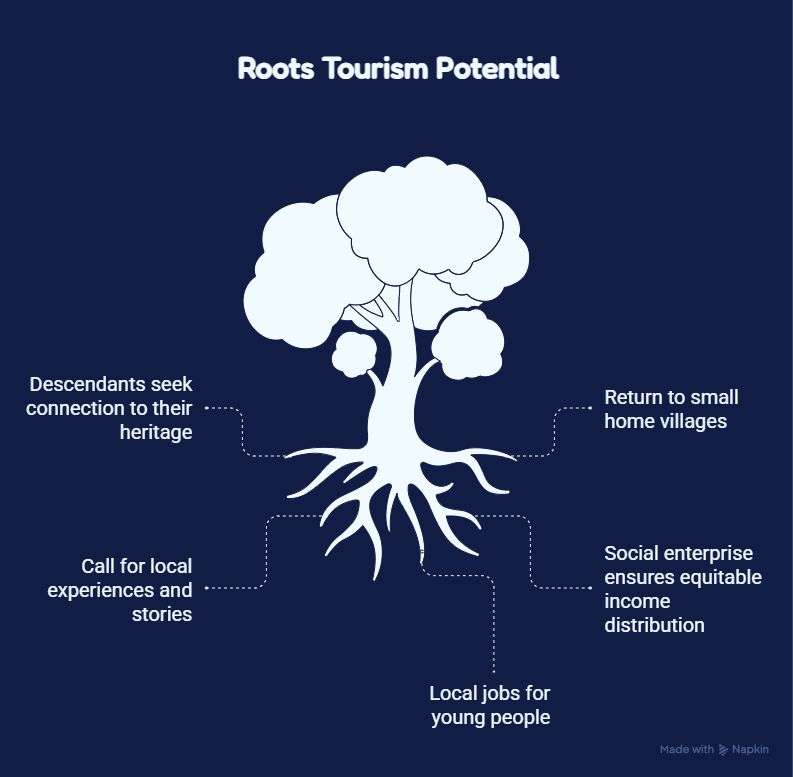
In broader discussions about the future of inland and peri-urban areas, one of the most complex challenges identified within the CREASSE project ecosystem concerns depopulation. Partner countries such as Italy, Spain and Greece share a common reality: small rural villages that risk losing their identity due to the migration of young people to large urban centres. However, there is a hidden resource, invisible yet possessing immense economic and social potential, which is moving in the opposite direction: the millions of descendants of those historic migratory flows who today wish to rediscover the land of their ancestors. This is the phenomenon of Roots Tourism.
This trend is not merely a temporary holiday phenomenon, but represents an unprecedented opportunity for cultural and economic regeneration for local communities. However, for this resource to translate into genuine and sustainable development, it cannot be left in the hands of purely commercial interests or large external tourism agencies. The answer lies in the models of the Social and Solidarity Economy (SSE) and, specifically, in Community Cooperatives.
What is Roots Tourism and why does it concern inland areas
Roots Tourism identifies a category of travellers driven not by the dynamics of mass tourism or standardised commercial itineraries, but by a search for a deep sense of identity and cultural connection with the local area. These flows often concentrate in disadvantaged and inland geographical areas, characterised by a lack of infrastructure and demographic decline. It is precisely in these contexts that traditional tourism models fail, unable to achieve economies of scale, and where social enterprises can thrive, unlocking latent resources through social innovation. The ‘roots traveller’ rejects the role of a mere passive consumer of services; on the contrary, they aim to integrate temporarily into the social and economic fabric of the village, effectively becoming a temporary citizen, an actor capable of co-producing value alongside the host community.
Community cooperatives as hubs for service design and infrastructure management
To address and structure this demand, a participatory business model based on asset-sharing and the design of integrated services is required. Community cooperatives perfectly embody the principles of the Social and Solidarity Economy (SSE), operating as multi-sectoral social enterprises that optimise underutilised local resources through the principles of generative welfare. Instead of being subject to the value extraction typical of large global digital platforms, this model centralises governance and decentralises benefits, acting as a genuine system aggregator for the local area. The cooperative does not replace the existing productive fabric, but acts as a connecting infrastructure for local micro-enterprises, overcoming the fragmentation and logistical constraints that often isolate rural areas.
This cooperative architecture realises its full potential when it combines the integration of short supply chains with the digitisation of cultural heritage. Through the development of shared digital ecosystems, the cooperative enables agricultural, craft and hospitality businesses to network, offering temporary visitors a single, integrated interface to experience the area. At the same time, the village’s historical memory and identity are digitised in the cloud and mapped using geolocation technologies, creating smart tourism routes that do not impact the physical liveability of the place but enhance its scientific and cultural appeal. In this way, the economic impact of the tourist flow is distributed in a widespread and inclusive manner; the visitor’s experience does not end with the conclusion of their stay, as the digital infrastructure enables them to maintain a permanent commercial and relational channel with the network of local businesses, transforming a temporary phenomenon into a continuous and sustainable export supply chain.

The role of Social Facilitators, Gen Z and skills
Within this ecosystem of local innovation, the role of the Social Facilitator – as promoted in CREASSE’s training modules – functions as a strategic project manager in its own right. Their main task is to apply advanced community engagement methodologies and data analysis to identify the area’s untapped resources and align them with the technical skills required to run a social enterprise. This systemic approach transforms inland areas into veritable experimental laboratories for the new generations of professionals, offering young social entrepreneurs the opportunity to apply high-value technological and logistical skills directly in rural contexts, reversing the flows of brain drain towards urban centres.
It is precisely within this dynamic that Gen Z plays a leading role, proving that they have an additional advantage. Born in a time of transition and raised in a digital world, the young people of this generation do not merely use technology; they integrate it naturally into the way they think and interact. Gen Z possesses an intuitive digital fluency combined with a keen awareness of environmental sustainability and social equity. This unique combination of values and aptitudes makes them the ideal candidates to take on the role of Social Facilitator, capable of acting as ‘cultural bridges’ that can translate technological complexity into accessible solutions with a significant human impact for local communities.
These new professionals thus become the architects of the twin transition – digital and ecological – within the community cooperative. Through the use of data analytics tools, the management team is able to monitor visitor flows, analyse usage patterns and optimise destination positioning campaigns on international digital channels. Furthermore, the implementation of enabling technological solutions (from improving the efficiency of local energy resources to managing cloud platforms for regional e-commerce) requires a set of STEM skills and Agile Project Management expertise that profoundly modernises the economy of the villages. The territory’s sense of identity is thus freed from purely conservative approaches and transformed into an advanced, scalable and resilient economic model, capable of engaging on equal terms with the global Social and Solidarity Economy market.

Towards an integrated European rural ecosystem
The success of the economic transition in inland areas ultimately depends on the ability to connect local identities with global networks, whilst safeguarding the social cohesion of these regions. When ‘Roots Tourism’ is freed from the exploitative logic of traditional commercial models and managed through the democratic infrastructure of community cooperatives, it ceases to be merely a market niche and becomes a long-term strategy for social innovation.
The involvement of new generations of professionals within these multi-sectoral enterprises represents the fundamental link for steering change, ensuring that the digitisation of heritage and the integration of supply chains remain firmly anchored to the principles of local reinvestment and collective well-being. In line with European strategic objectives for the growth of marginalised communities, enhancing the transnational ties of temporary residents means not only countering demographic decline, but also demonstrating in practice that the geographical periphery can become the driving force behind a more equitable, circular and interconnected economy.