Lessons from Albania’s Experience
What if an asset once associated with organised crime could become a place where people find employment, young people build skills, women improve livelihoods, or communities come together?
This is the idea behind the social reuse of confiscated assets, an approach that moves beyond simply taking illicit assets away from criminal organisations and asks a more ambitious question: how can their value be returned to society?
Confiscation is an important instrument in the fight against organised crime. It removes economic resources and weakens the power of criminal networks. But the story does not have to end there. What happens afterwards matters too. When a confiscated asset is placed at the service of communities, it can become a resource for social inclusion, entrepreneurship and local development.
This is where social and solidarity economy and social entrepreneurship can play a distinctive role.
FROM CONFISCATION TO SOCIAL VALUE
Social reuse represents a shift from viewing confiscated assets simply as an asset to be administered or sold, towards seeing it as a potential community resource. It means putting confiscated assets to legitimate social, economic or community use, for example, by assigning it to a civil society organisation, municipality or other eligible actor that can transform it into a social service, community space or income-generating activity with a social purpose. In this sense, social reuse is not only about finding an asset a new use; it is about creating economic activity around social needs, community participation and the shared values and principles at the heart of the social and solidarity economy.
The European Union (EU) has increasingly recognised this potential. The EU Directive 2024/1260 (1) encourages Member States to enable the use of confiscated assets for public-interest or social purposes, recognising the potential of social reuse to strengthen communities.
The idea is particularly powerful because the transformation is both practical and symbolic. The asset remains physical, but its purpose, ownership and value for society can change fundamentally.
THE EXAMPLE OF ALBANIA: FROM EXPERIMENTATION TO A SUSTAINABLE MODEL
Albania offers an interesting case of how this approach can develop through experimentation, learning and partnership.
Launched in 2016, C.A.U.S.E. – Confiscated Assets Used for Social Experimentation, was the first initiative of its kind in Albania and the Western Balkans. Supported financially by the European Union, the initiative was implemented by Partners Albania for Change and Development in partnership with Project Ahead and Comitato Don Peppe Diana (2). In cooperation with the Agency for the Administration of Seized and Confiscated Assets in Albania (AAPSK), C.A.U.S.E explored the potential whether confiscated assets could become foundation for the development of sustainable social enterprises in Albania.
The result was the establishment of three social enterprises in Fier, Durrës and Saranda, each responding to different community needs.
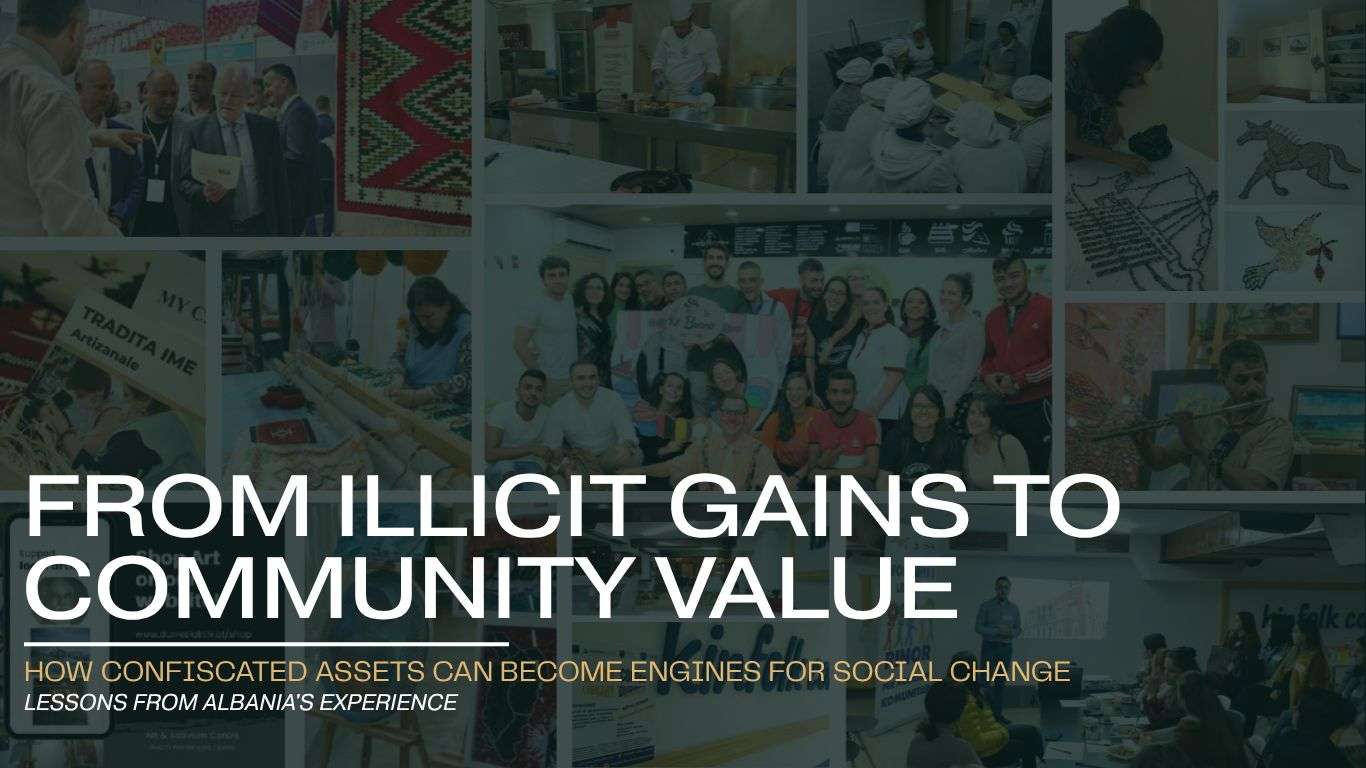
KeBuono! Social Pastry in Fier, the first social enterprise established in a confiscated asset in 2018, combines pastry production with vocational training and employment opportunities for vulnerable people, including former convicts and families of prisoners facing difficult socio-economic conditions. KinFolk Coffee Library in Durrës transformed a confiscated asset into a café with a library and community space, creating opportunities for young people, especially those at risk of juvenile delinquency, to meet, learn and participate in cultural and social activities alongside an income-generating business. In Saranda, Social Crafting Garage, a workshop focused on stone handicrafts production, provided skills development opportunities and access to employment for women and girls at risk of domestic violence.
These three experiences demonstrated something important: there is no single formula for social reuse. A confiscated asset becomes valuable when it is connected to local needs, capable organisations and an activity that can generate both social and economic value.
FROM C.A.U.S.E. TO TWIST: TAKING THE MODEL FURTHER
C.A.U.S.E. showed that the concept could work. The next question was how to make such an approach broader, more sustainable and more connected to the wider ecosystem.
This was the ambition of TWIST – Towards a New Social Entrepreneurship Model in Confiscated Assets in Albania (3), a project implemented by Partners Albania for Change and Development in partnership with LIBERA. Associazioni, nomi e numeri contro le mafie and Tirana Municipality, with the cooperation of the Agency for the Administration of Seized and Confiscated Assets (AAPSK). Building on the experience and lessons of C.A.U.S.E, TWIST strengthened the legal and institutional framework by providing evidence, analysis and legal recommendations to increase the role of municipalities in the social reuse of confiscated assets (4), while promoting the replication of the model at local level beyond the initial pilot locations. As part of this expansion, a new social enterprise was established in Durrës, meanwhile another SE in a confiscated asset in Elbasan was supported to scale up its activity.
More specifically, in Durrës, Center Art and Activism transformed a confiscated asset into a space for artistic creation, exhibitions, workshops, cultural and civic engagement activities, supporting young artists and creators. In Elbasan, My Traditional Craft builds on traditional craftsmanship by training and employing local women in handloom weaving and the production of handmade products, while preserving and promoting local cultural heritage.
Together, C.A.U.S.E. and TWIST represent an evolution: from proving that social reuse can work, to building the conditions for a more sustainable and replicable approach. This model has been replicated by other organizations as well, while AAPSK has taken on a more active role in promoting social reuse and collaborating with other stakeholders to facilitate the reuse of confiscated assets for social purposes. This growing engagement reflects the broader value of the model, as these initiatives have not only created individual social enterprises but also helped raise awareness and build a stronger understanding among institutions and other actors of the potential of confiscated assets as resources for social and community development, encouraging them to become more engaged and proactive in supporting and advancing social reuse processes.
WHAT CAN ALBANIA’S EXPERIENCE TEACH OTHERS?
Albania’s experience is particularly valuable because it shows that social reuse does not have to start with a large and fully developed system. It can begin with experimentation, partnerships and learning by doing.
Three lessons stand out.
First, start with communities, not assets. The question should not simply be what can be done with a confiscated building, but what the community needs and how that asset can contribute to addressing those needs.
Second, treat social reuse as an ecosystem, not an allocation procedure.
No single actor can make the model work alone. Institutions responsible for confiscated assets, municipalities, civil society organisations, social enterprises and local communities all have different roles to play. However, beyond fulfilling their individual roles, these actors need to work together, as collaboration is key to ensuring that efforts are aligned, complementary and focused on what is needed to make social reuse work and create lasting value.
Third, invest in capacity, not only in assets. A building does not create social impact on its own. Organisations need entrepreneurial, managerial and financial capacities; beneficiaries may need skills and employment support; and social enterprises need viable business models. Partners Albania’s approach of combining financial support, capacity building and stronger institutional cooperation reflects this lesson.
MAKING THE MODEL TRANSFERABLE
For social reuse to spread beyond individual projects, the knowledge and experience generated through these initiatives need to become accessible and adaptable.
This is why Partners Albania’s “Establishment of Social Enterprises in Confiscated Assets from Organized Crime – Practical Guide” (5) is an important contribution. Developed specifically within the Albanian legal and institutional context, the Guide provides practical information on the steps organisations need to follow, the responsible institutions, the relevant legal framework, and examples of social entrepreneurship initiatives.
While the Guide is designed for Albania, its practical approach and methodology can also serve as a useful reference for other countries exploring social reuse. The legal and institutional arrangements will naturally differ from one context to another, but the underlying process can be adapted: identifying community needs, assessing the potential of assets, building the right partnerships, developing a viable social enterprise model, securing institutional support, investing in people and measuring the results.
Albania’s experience also shows the importance of learning from countries where social reuse has developed over a longer period and at greater scale. Italy offers one of the most established examples of this approach (6). Since the 1990s, confiscated assets have increasingly been assigned for social purposes, supported by a long-standing framework for social reuse that has brought together a broad network of civil society organisations, municipalities and other actors to transform them into community services, employment opportunities and local development initiatives. LIBERA’s latest mapping identifies 1,332 civil society organisations involved in managing confiscated assets across 448 municipalities and 19 regions in Italy, illustrating the potential of social reuse when individual initiatives become part of a wider ecosystem (7).
Replication, therefore, should not mean copying the same approach or model everywhere. What can be transferred is the approach: learning from what has already been tested, while allowing each solution to respond to its community’s needs, resources and context. For other countries exploring social reuse, the opportunity lies in adapting what works and building the institutional and community conditions that allow such models to take root and develop over time.
FROM CONFISCATED ASSETS TO SHARED COMMUNITY VALUE
The most powerful lesson is ultimately a simple one: a confiscated asset does not automatically become a social asset simply because it changes hands. It becomes one when its physical value is combined with people, purpose, entrepreneurship and the needs of the community. When this happens, confiscation becomes more than a mechanism for taking something away from crime, it becomes a way of giving value back to society.
The challenge ahead is to move from individual success stories towards systems that make social reuse an increasingly accessible, sustainable and replicable option, allowing more communities to turn crime into opportunities for a better future.
Sources
1. https://eur-lex.europa.eu/legal-content/en/TXT/?uri=CELEX%3A32024L1260
2. https://www.partnersalbania.org/publication/cause-confiscated-assets-used-for-social-experimentation-initiative/
3. https://www.partnersalbania.org/News/the-twist-project-towards-a-new-social-entrepreneurship-model-in-confiscated-assets-in-albania/
4. https://www.partnersalbania.org/wp-content/uploads/2024/07/Social-reuse-of-confisc-assets-by-CSOs-with-an-increased-role-of-LG.pdf
5. https://partnersalbania.org/wp-content/uploads/2020/09/PRACTICAL-GUIDE-FOR-NPOs.pdf
6. https://www.libera.it/it-schede-1829-beni_confiscati_modello_italiano_si_diffonde_in_ue
7. https://www.libera.it/documenti/schede/2026_pubblicazione.pdf